Why does an AI product demo look right until it moves?
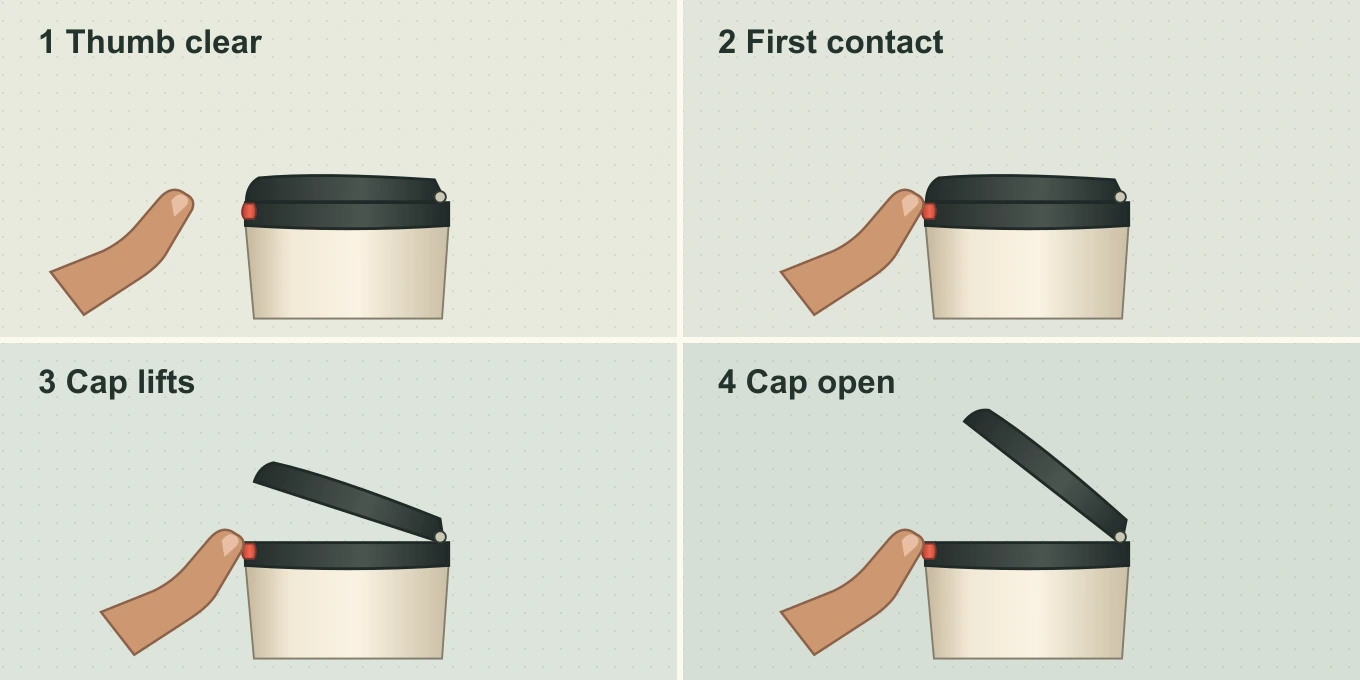
Play the close-up with the sound off. Look for the first frame where the lid starts to rise. Where is the thumb? If there’s still daylight between the thumb and the release button, you’ve found the problem. The ad has a convincing picture of a closed cup and a convincing picture of an open cup. The few frames connecting them say the cup opened by itself.
For a shop selling one-handed opening, those few frames are the demonstration. Here’s how to review them, what a more precise motion brief can fix, and how to keep the surrounding drama when a real insert would do a better job.
Watch the real mechanism once before you write the prompt
Try the move with the exact model you ship. For this example, imagine a thumb pressing a red release on the front rim. The rear hinge stays attached and the cap swings up. Does your cup have a safety slider? Does it need a second hand to steady it? Does the cap spring all the way back, or does the thumb finish the movement? A line as simple as “she pops the lid” leaves all three questions for someone else to answer.
Record one ordinary opening on your phone and keep the sound. It gives the editor a reference for the click as well as the motion. Watch it first with the sound muted. Write down what you can actually see. The release mechanism inside an opaque lid can stay off camera. The outside of the cup already gives you three witnesses to the action — the thumb, the cap edge nearest the thumb and the hinge on the far side.
Inspect the transition between two good stills
It’s easy to approve the first and last images on a storyboard. Neither image tells you how the lid got from one position to the other. Many paths lead to the same final pose. The cap could slide upward, detach and settle back onto the hinge, or swing naturally around a fixed pin. An image-to-video model can produce a plausible-looking sequence even when the intermediate motion is wrong for your hardware. OpenAI documented an early example of a physical action failing to leave its expected mark in its Sora research examples on cause and effect.
In your editor, park the playhead just before the cap lifts. Step forward a frame at a time through the release, then play the same section at normal speed. A fast spring can move between two captured frames. You don’t need a picture of every millimeter. You do need a sequence that a viewer can reconcile with the real take. Look for the earliest disagreement.
- The cap moves while the thumb is still approaching. Check the last closed frame for a visible gap. If there is still a gap when the first sliver of the opening appears, moving the click sound later will leave the same contradiction on screen.
- The thumb touches, but the entire lid floats upward. Follow the rear hinge relative to the cup rim. If they separate, the shot shows the lid coming off. A shopper looking for a hinged cap just saw a different mechanism.
- The hand hides the release for the whole action. The mechanism may be correct, but this view gives you too little evidence to judge. Rotate the cup or lower the camera until you can see the front edge lift past the thumb.
If the button changes location before anyone touches it, fix the product reference and camera angle first. Otherwise you’ll spend a take directing the hand toward a button your customer’s cup doesn’t have.
Give the generator one movement to solve
Imagine the original prompt asks the commuter to pull out the cup, turn toward the window, wink and pop the lid while the camera circles her. Keep the wink in the reaction shot. For the insert, start with the cup in the hand, the button visible and the camera still. Where an image-to-video tool accepts a first frame, supply that composition. Start the motion brief at the first visible change.
The thumb presses the red button. As it presses in, the front edge of the cap lifts and swings up around the rear hinge. The hand holds the cup steady. Hold on the open lid.
Ask for the action your phone reference shows. A thumb that has to lift a stiff cap needs a different line from a spring-loaded release. Compare the retry against the same three points you used before. This makes the review quick even if the new take looks much prettier.
Keep the drama and film the part that sells the cup
If the purchase depends on seeing the one-handed release, a single continuous phone take can settle it. Prop the phone beside a window, use the same hand and sleeve as in the approach shot, and frame both the button and hinge. Leave a moment of stillness at each end. Cut from the commuter’s glance to the closed cup, play the whole press and lift, then cut back to her reaction. Matching the direction of her reach will do more for the edit than recreating the entire train carriage.
Put a concrete request in the brief for the person filming. “Keep rolling from the thumb clear of the button until the cap settles. I need to see the hinge throughout.” For the final check, show someone the muted ad on a phone and ask them to demonstrate the move on the real cup. Watch where their thumb goes. That tells you what your edit taught them.